What Patients Say, What Doctors Hear by Danielle Ofri
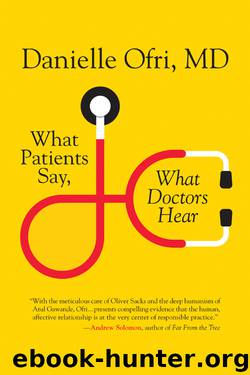
Author:Danielle Ofri [Ofri, Danielle]
Language: eng
Format: epub
ISBN: 978-0-8070-6264-7
Publisher: Beacon Press
Published: 2016-11-28T16:00:00+00:00
Thus far, I’ve focused on how much patients remember of what doctors say. But I often wonder about the opposite: how much do doctors remember of what patients say? I hunted for research studies on that topic, and surprisingly (or unsurprisingly) could find none. There were no comparable studies testing what doctors remember of patients’ names, diagnoses, or medical histories. I suppose this might seem like a ridiculous question because, after all, doctors have spent so many years memorizing for medical school that they must be good at remembering patients’ information. Plus they have that handy medical chart with everything written down, right?
There were only small tangential studies about how much doctors recall of the information they read in medical journals (embarrassingly little)8 or how well they remember clinical information from a fictionalized case study (full-fledged doctors do better than medical students),9 but nothing with real patients.
There is one real-life experiment regarding physician memory that happens, unfortunately, a little too regularly. Electronic medical records have been revolutionary in many respects—a patient’s chart can no longer be adrift in the cardiology clinic and a crucial X-ray can’t be languishing in a surgeon’s back pocket. However, by dint of being computerized, such information is susceptible to the same glitches as every other bit of computerized material. In the middle of writing your Tolstoy-worthy note about a patient with sixteen illnesses, the computer freezes, or the program crashes, or you inadvertently hit “escape” or “delete” at an inopportune moment, and all of your carefully wrought observations evaporate into the ether.
At least once a day, it seems, a medical student or intern will turn up, ashen-faced, stammering with incomprehensibility about the note they just lost, about all their efforts that just went up in smoke. Even the old hands at the hospital, who’ve learned the electronic landmines in trial-by-fire experience, are not immune. Recently I’d been writing a particularly complicated note about a patient with multiple chronic illnesses who was on more than a dozen medications and had numerous lab values out of whack, when I was interrupted by a phone call about an abnormal X-ray for a different patient. I had to open that patient’s chart to untangle that issue. After sorting through that second patient’s medical history and what to do about the X-ray, I went to close the second chart so I wouldn’t commit the cardinal sin of mixing up two charts.
It took only a fraction of a second. Before I’d even released my finger from the mouse, I realized I’d closed the wrong tab. I kept my finger depressed on the mouse as long as I could, hoping that I could will that brief gesture into reverse, that I could telepathically conjure the information back onto the screen. When my irrational hopes could be sustained no longer and the boulder of despair had fully dropped anchor into my deepest bowels, I released my finger in agonizing slow motion.
I remained in vigorous denial for as long as I could, but finally my brain was forced to articulate what I already knew in my heart: I’d just lost everything.
Download
This site does not store any files on its server. We only index and link to content provided by other sites. Please contact the content providers to delete copyright contents if any and email us, we'll remove relevant links or contents immediately.
| Administration & Medicine Economics | Allied Health Professions |
| Basic Sciences | Dentistry |
| History | Medical Informatics |
| Medicine | Nursing |
| Pharmacology | Psychology |
| Research | Veterinary Medicine |
Periodization Training for Sports by Tudor Bompa(8278)
Why We Sleep: Unlocking the Power of Sleep and Dreams by Matthew Walker(6729)
Paper Towns by Green John(5196)
The Immortal Life of Henrietta Lacks by Rebecca Skloot(4593)
The Sports Rules Book by Human Kinetics(4398)
Dynamic Alignment Through Imagery by Eric Franklin(4223)
ACSM's Complete Guide to Fitness & Health by ACSM(4062)
Kaplan MCAT Organic Chemistry Review: Created for MCAT 2015 (Kaplan Test Prep) by Kaplan(4015)
Introduction to Kinesiology by Shirl J. Hoffman(3778)
Livewired by David Eagleman(3778)
The Death of the Heart by Elizabeth Bowen(3626)
The River of Consciousness by Oliver Sacks(3607)
Alchemy and Alchemists by C. J. S. Thompson(3526)
Bad Pharma by Ben Goldacre(3429)
Descartes' Error by Antonio Damasio(3284)
The Emperor of All Maladies: A Biography of Cancer by Siddhartha Mukherjee(3166)
The Gene: An Intimate History by Siddhartha Mukherjee(3100)
The Fate of Rome: Climate, Disease, and the End of an Empire (The Princeton History of the Ancient World) by Kyle Harper(3070)
Kaplan MCAT Behavioral Sciences Review: Created for MCAT 2015 (Kaplan Test Prep) by Kaplan(2988)
